
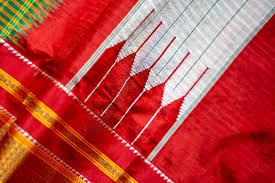
 Ilkal sarees are among Karnataka’s most recognisable handloom textiles, admired for their bold colour combinations, architectural borders, and a unique weaving method that physically joins different parts of the saree on the loom itself. Woven in and around the town of Ilkal in Bagalkot district, this tradition represents a rare blend of technical ingenuity and deep-rooted cultural identity.
Origins of Ilkal Weaving
Ilkal has been a weaving centre for generations, with historical references suggesting that the craft has been practiced for several centuries. Situated along traditional trade routes, the town became a hub where cotton and silk yarns were readily available, allowing weavers to develop a distinctive regional style.
The Unique Weaving Process
Tope Teni Technique
One of the most remarkable aspects of Ilkal weaving is the “tope teni” technique. Instead of weaving the saree as a single continuous warp, the pallu warp is separately prepared and later joined to the body warp on the loom using an intricate interlocking method. This join is executed so seamlessly that the transition becomes part of the saree’s design rather than a structural compromise.
Yarns and Borders
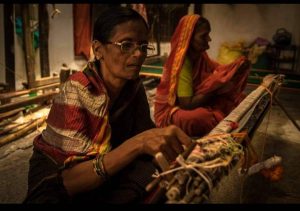 Ilkal sarees are traditionally woven using cotton for the body and art silk or silk for the pallu, though pure silk versions also exist.
The borders often feature temple-inspired patterns, stepped designs, and bold stripes that echo architectural forms. These borders are woven using extra weft techniques that create raised or contrasting effects.
Pallu Design
The pallu is instantly recognisable for its distinct red field with white patterns, often arranged in stripes or small checks. This red-and-white combination is a signature of Ilkal sarees.
Continuity and Adaptation
While powerloom imitations exist, authentic Ilkal sarees remain handwoven, preserving the structural join that defines the craft. Contemporary adaptations include lighter colour palettes, softer yarns, and new border variations aimed at younger buyers.
Ilkal sarees stand as a testament to how technical innovation and cultural memory can be interwoven on a loom, producing a symbolically powerful textile.
Image References
https://pkguledilkalsarees.com/
https://www.sid-thewanderer.com/2022/07/Ilkal-handloom-saree-karnataka-tvami.html