
Roots of the Craft
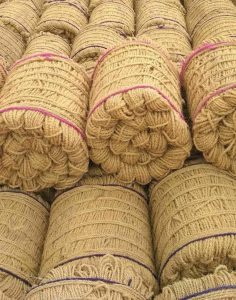 In the rural landscapes of Karnataka, artisan communities practice the age-old craft of coir making, transforming coconut husk fibre into strong, biodegradable products.
Though Karnataka is better known for its coastal coconut belts, interior clusters such as those around Javagal developed coir skills through trade links and raw material access from nearby coconut-growing areas.
For generations, families have practised fibre extraction, rope making, and mat weaving as part of their rural economy. The craft provided supplementary income alongside farming, ensuring year-round work even outside agricultural seasons.
Retting and Fibre Extraction
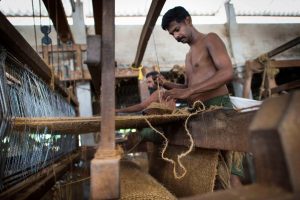 The process begins with “retting”, where coconut husks are soaked in water; often in ponds or slow-moving streams for several weeks. This softens the pith and loosens the fibres. Once retted, the husks are beaten with wooden mallets or mechanical beaters to separate the coarse fibres.
These fibres are then washed, dried, and sorted according to length and strength. Longer fibres are preferred for spinning strong yarns, while shorter ones may be used for stuffing or cushioning materials.
Spinning, Twisting and Braiding
Dried fibres are spun into yarn using hand-operated spinning wheels or simple mechanical spinners. The spinner draws out the fibres and twists them into continuous strands, controlling thickness and tension to suit different end uses.
Multiple strands of yarn may be twisted together to create thicker ropes. This twisting enhances strength and durability, making coir rope suitable for heavy-duty applications.
Weaving and Product Formation
The spun yarn is then woven or knotted into various products like floor mats, doormats, ropes and cords, baskets, storage items etc.
Design, Function, and Durability
Coir products are known for their toughness, resilience to moisture, and resistance to wear. The fibre’s coarse texture makes it ideal for doormats and brushes that remove dirt effectively.
Recognition and Adaptation
National institutions such as the Coir Board of India promote coir products domestically and internationally, supporting clusters with training, technology upgrades, and market access. While traditional ropes and mats remain staple products, contemporary coir artisans are expanding into contemporary items like Coir-based home décor accessories, Geotextiles for soil conservation and landscaping etc.
Image References
https://www.tripinvites.com/places/alleppey/coir-weaving/photos-of-coir-weaving/